


Reading time: 10 minutes
Table of Contents
- Introduzione
- History of Castello Serravalle
- Architecture and Structure
- Legends of the Castle
- How to Visit Castello Serravalle
- When to Visit
- The Castle and the View Over Bosa
- Events and Festivals
- Tips for Visiting
- Conclusion
Introduction
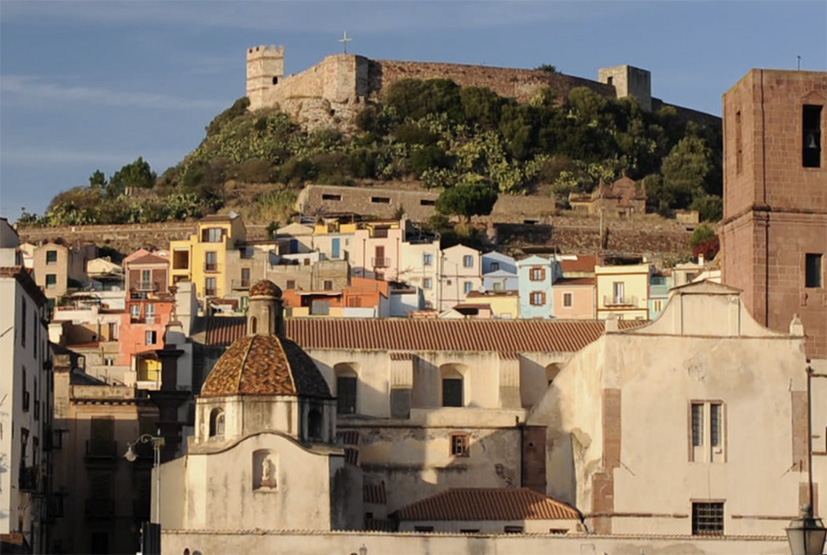
Majestically overlooking the horizon of Bosa, an ancient river town in western Sardinia, Castello Serravalle (also known as Castello Malaspina) stands as one of the most fascinating testimonies to the island's medieval past. Perched atop the hill that dominates the town, this fortress offers not only a journey through history but also one of the most spectacular panoramic views you can admire in this part of Sardinia.
For anyone wondering about things to see in Bosa, the castle undoubtedly represents the first must-see stop on any itinerary. Its imposing silhouette, visible from every corner of the town, has become over the centuries the very symbol of Bosa, a reference point that is not only geographical but also part of the local identity.
Built in an era when control of territory was fundamental for political and military power, Castello Serravalle has witnessed centuries of history, silently observing the succession of dominations, wars, periods of splendor and decline. Today, while preserving only part of its original structure, it continues to tell the complex historical story of Bosa and Sardinia through its ancient stones.
In this article, we will explore the history of the castle, its architecture, the legends that surround it, and all the practical details on how to visit this extraordinary historical attraction that represents one of the main things to do in Bosa for anyone wishing to understand the authentic soul of this corner of Sardinia.
History of Castello Serravalle
The Medieval Origins
The history of Castello Serravalle begins in the 12th century when the powerful Genoese Malaspina family decided to build a strategic fortress on the summit of the hill that dominates Bosa. This decision was not random: during that period, Sardinia was divided into four Giudicati (independent kingdoms), and control of a strategic point like Bosa, with its navigable river and coastal position, represented a significant political and commercial advantage.
It was the marquises Malaspina dello Spino Secco who initiated the construction of Castello Malaspina around 1112. The building of the fortress marked a crucial moment in the history of Bosa: the inhabited center, which in Roman times was located further downstream in the area now known as Bosa Vetus, was gradually moved to the slope of Serravalle hill, seeking protection in the shadow of the castle.
Under Malaspina rule, Castello Serravalle became the political and military heart of a territory that included not only Bosa but also vast surrounding areas. The elevated position allowed control of both the mouth of the Temo River and a large stretch of coast, essential for preventing attacks from the sea in an era of frequent incursions.
The Aragonese Period
In the 14th century, with the arrival of the Aragonese in Sardinia, Bosa and its castle also came under the control of the Crown of Aragon. This period marked important transformations for Castello Malaspina, which was expanded and further fortified to adapt it to new military techniques and the needs of Iberian domination.
It was during the Aragonese period that the Church of Nostra Signora di Regnos Altos was built within Castello Serravalle, a splendid example of Gothic-Catalan architecture that constitutes today one of the main points of interest for those wishing to visit the fortress. The church was decorated with a cycle of frescoes of remarkable artistic value, representing a unique masterpiece in the panorama of medieval Sardinian art.
In the following centuries, under Spanish and later Savoyard rule, the castle maintained its strategic importance but gradually began to lose its residential function. Local noble families preferred to build more comfortable and luxurious palaces in the center of Bosa, leaving the fortress on the hill to serve primarily as a defensive structure.
Abandonment and Restoration
With the evolution of military techniques and the decrease in external threats, between the 17th and 18th centuries, Castello Serravalle gradually lost its defensive function. This marked the beginning of a long period of abandonment and decay, during which many structures collapsed and others were dismantled to recover building materials.
The church also ceased to be used and maintained. Only in 1847, among the ruins of the castle, a boy found a wooden statue depicting the Virgin breastfeeding the Baby Jesus (Virgo lactans). This discovery, considered miraculous, led to the decision to dedicate the castle’s church to the Madonna, who was invoked under the title Nostra Signora de Sos Regnos Altos, in reference to the elevated position of the sanctuary, from where it is believed the Virgin protects the town from above.
As for the rest of the complex, it wasn’t until the 20th century that there was a renewed interest and the first restoration and enhancement efforts began.
In recent decades, thanks to various restoration campaigns, Castello Malaspina has once again become a living symbol of the city and one of the main tourist attractions in Bosa. Today, it stands out as one of the most important things to see in Bosa and in all of western Sardinia, attracting many visitors who appreciate both its historical and artistic value and its extraordinary panoramic location.
Architecture and Structure
Walls and Towers
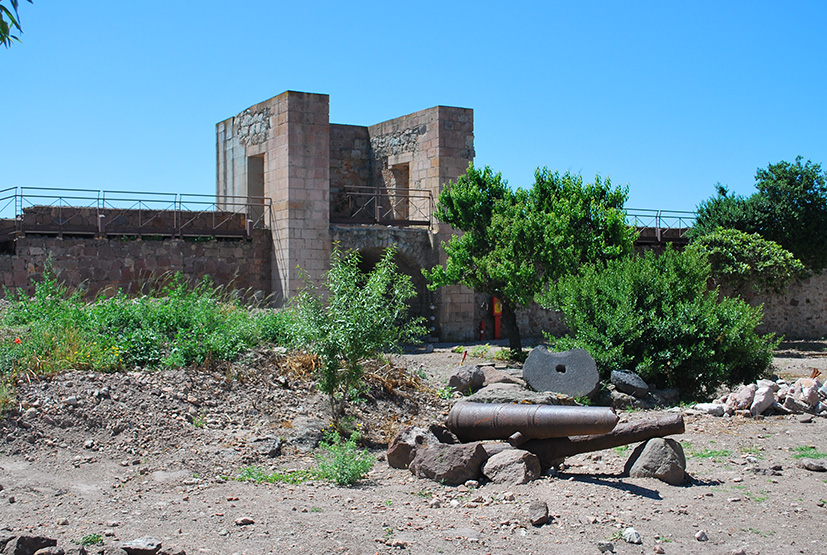
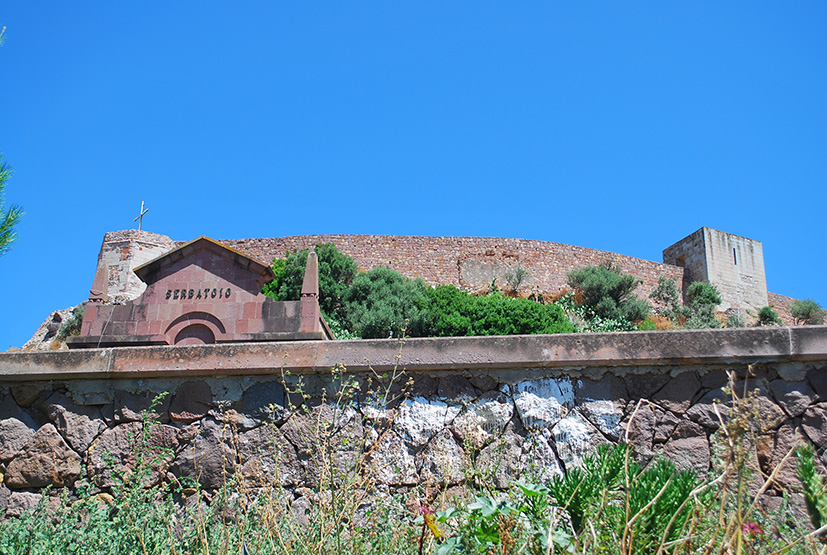
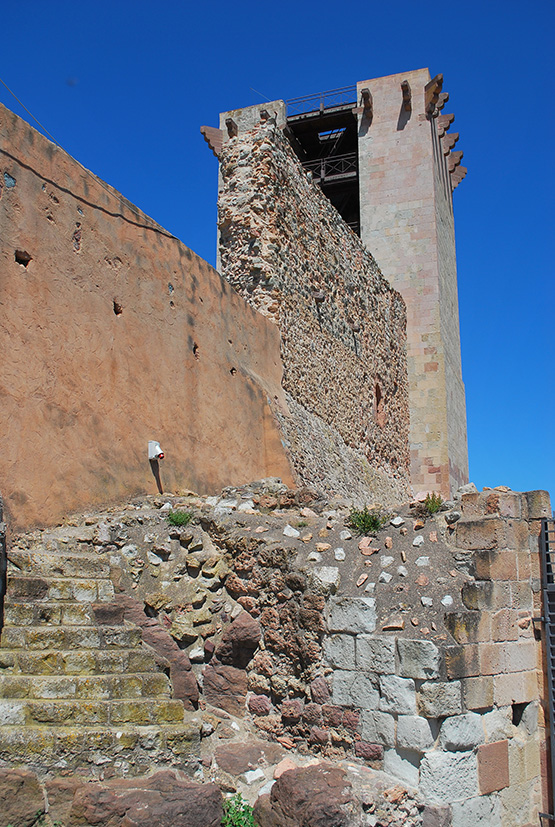
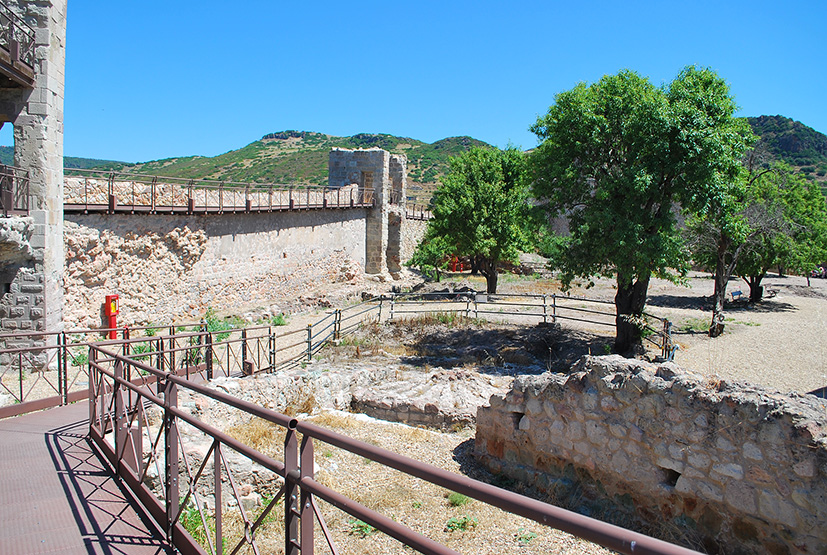
Castello Serravalle features an irregular layout that follows the natural shape of the hilltop on which it stands. Of the original complex—once much larger and more elaborate—what remains today are mostly the perimeter walls and a few towers, which still allow visitors to understand the scale and strategic importance this fortress held during the Middle Ages.
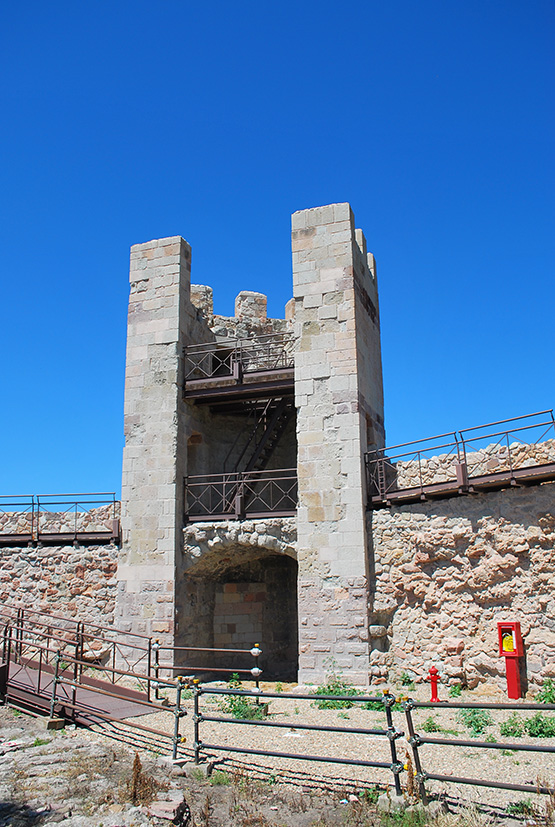
The walls, built with blocks of a local volcanic stone called light pink trachyte, stretch for about 352 meters, forming an irregular polygon. The thickness of the walls—reaching up to two meters in some areas—attests to the purely defensive function of the structure, designed to withstand sieges and the warfare techniques of the time.
Of the original seven towers, only three remain visible today. These square-shaped towers are strategically positioned along the defensive perimeter. From them, sentinels could keep watch over a vast area, from the mouth of the Temo River to the surrounding hills and the coastal stretch extending both north and south of Bosa.
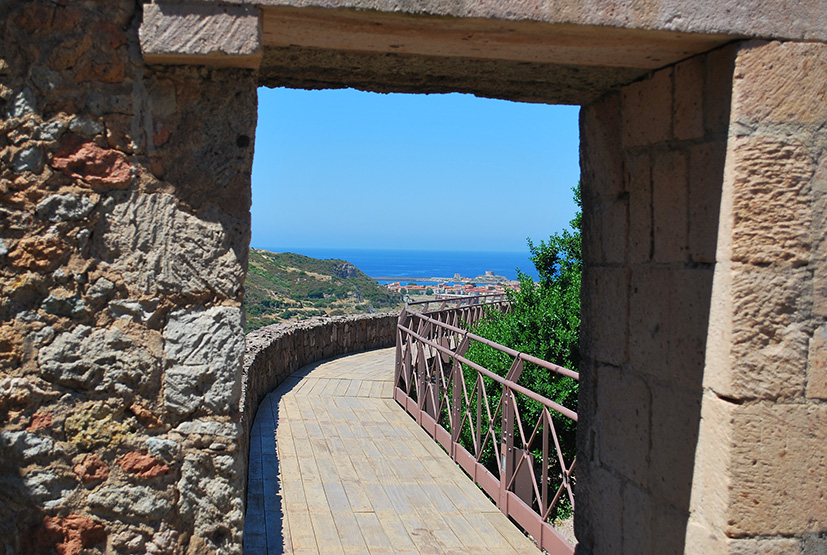
The original entrance to the castle is located on the eastern side and consists of a round-arched gateway, also made of trachyte. Passing through this threshold leads to what was once the inner courtyard of the fortress—now an open space offering a spectacular view of Bosa, the river, and the sea.
The Church of Nostra Signora di Regnos Altos
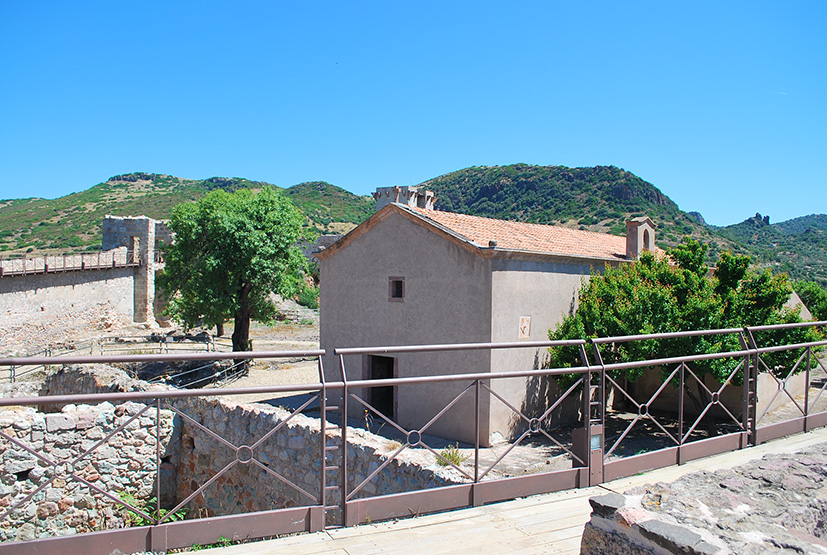
The architectural and artistic jewel of Castello Malaspina is undoubtedly the Church of Nostra Signora di Regnos Altos, built in several phases but completed in the first half of the 14th century within the fortified perimeter. The very name of the church, which in Sardinian means “Our Lady of the High Realms,” seems to allude to its elevated position, but it also holds symbolic significance tied to the Marian devotion.
The building features a simple rectangular layout with a single nave, wooden truss roofing, and an apse oriented according to Christian tradition. The façade, sober and essential, is marked by a lintelled portal topped by a round arch, while a small bell gable rises at the top.
Despite its structural simplicity, the interior of the church hides a treasure of inestimable value: a cycle of 14th-century frescoes, probably created by artists of the Tuscan school, which represent one of the oldest and best-preserved examples of medieval wall painting in Sardinia.
The Frescoes of the Church
The frescoes of the Church of Nostra Signora di Regnos Altos, dated between 1340 and 1350, are one of the main reasons visitors choose to explore Castello Serravalle. These paintings, rediscovered only in the 1970s under layers of plaster that had protected them for centuries, offer an extraordinary glimpse into medieval art and spirituality.
The pictorial cycle unfolds along the side walls of the nave and in the presbytery area, depicting scenes from the New Testament and figures of saints. Among the most significant scenes are a Last Supper, a Crucifixion, an Adoration of the Magi, and an Annunciation. The style recalls early 14th-century Tuscan painting, with evident Giotto-inspired influences in the spatial composition and treatment of the figures.
The restoration of the frescoes, carried out using advanced techniques, has made it possible to recover much of their original vibrant color, returning to the Bosa community and its visitors an artistic treasure of exceptional value—one that alone justifies a visit to Castello Malaspina.
Legends of the Castle
The Ghost of the Lady of the Castle
Like every ancient manor worthy of the name, Castello Serravalle also has its legends and mysteries. Among the stories handed down through generations, one of the most fascinating is that of the ghost of a young noblewoman who, according to popular tales, appears on full moon nights among the ruins of the fortress.
It is said to be the spirit of a noble lady who lived in the 15th century, the daughter of the lord of the castle. She was forced by her father to marry a man she did not love, while her heart belonged to a young fisherman from Bosa. In despair, the young woman is said to have taken her own life by throwing herself from one of the towers, and her restless soul still wanders the walls of Castello Malaspina, searching for a peace she never found.
Romantics say that on summer nights, when the sea breeze caresses the Serravalle hill, one can hear the lady’s mournful cry calling out her lover’s name. Though part of folklore, this legend wraps Castello Serravalle in a veil of mystery that makes a visit all the more evocative—especially at sunset or under a moonlit sky.
The Jealous Marquis
Another well-known legend tells of the Marquis Malaspina, who was extremely jealous of his beautiful wife. He had a secret passage built from the castle to the cathedral, allowing her to move without being seen.
But even this precaution wasn't enough to calm the marquis’s jealousy. One day, in a fit of rage, he cut off the woman's fingers, wrapped them in a handkerchief, and stormed out. Later, calm and forgetful of his crime, he pulled out the handkerchief to blow his nose—only to see the fingers fall to the ground before the stunned eyes of those around him.
The marquis was immediately arrested and imprisoned. As for the fingers, legend has it they turned to stone and can still be seen, petrified, somewhere near the castle.
How to Visit Castello Serravalle
Opening Hours and Tickets
If you’re planning a visit to Castello Serravalle, the first thing to check is the opening hours, which vary by season. During the summer months (from June to September), the castle is generally open daily from 10:00 AM to 7:00 PMwithout a break. In the winter months (from October to May), hours are reduced, with access from 10:00 AM to 1:00 PM and from 3:00 PM to 5:00 PM. The site is closed on Mondays.
Admission is affordable (around €6.50 for adults, with discounts for children, students, and seniors), and includes access to both the fortified structures and the Church of Nostra Signora di Regnos Altos, with its precious frescoes.
Tickets can be purchased directly at the entrance or—during high season—reserved in advance at the Bosa Tourist Office to avoid queues. For large groups, booking in advance is recommended at any time of year.
Visit Itinerary
A visit to Castello Malaspina follows a path that allows you to explore the remains of the defensive structures, enjoy breathtaking views of Bosa and the surrounding landscape, and admire the frescoes in the Church of Nostra Signora di Regnos Altos.
The tour begins as you pass through the ancient entrance portal and continue into the inner courtyard, from where you can access the perimeter walls and what remains of the towers. Information panels, available in multiple languages, explain the castle’s history and the functions of its structures, helping visitors imagine how the fortress once looked at the height of its power.
The main highlight of the tour is, of course, the church, where you can admire the extraordinary 14th-century frescoes. At certain times of the year, guided tours led by local experts are available, adding value to the visit with fascinating details, stories, and legends of the castle that might otherwise go unnoticed.
The visit usually ends at the panoramic terrace, which offers a stunning 360-degree view: on one side, the historic center of Bosa, with its colorful houses climbing the hill; on the other, the Temo River winding its way to the sea; and on the horizon, the blue of the Mediterranean blending with the sky.
Accessibility
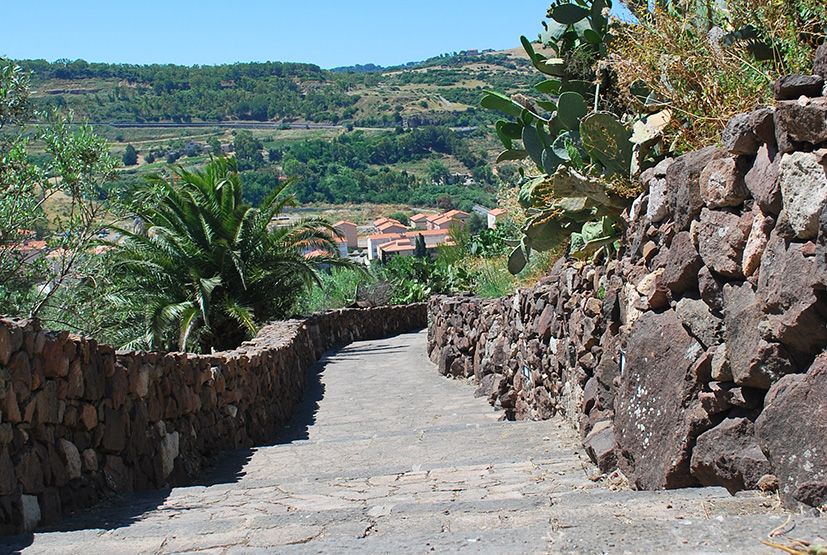
It is important to note that visiting Castello Serravalle comes with some accessibility challenges. The castle is located at the top of a hill, and reaching it requires walking up a steep path through the historic Sa Costa district, with its narrow and at times steep streets.
The walk from the center of Bosa to the castle entrance takes about 15–20 minutes uphill, which can be demanding on hotter days. There is no road that leads directly to the entrance, so even those arriving by car must park at the bottom and continue on foot.
Inside the site, uneven surfaces, steps, and elevation changes make the visit unsuitable for people with reduced mobility or wheelchair users. However, efforts to improve accessibility are ongoing, and some areas, such as the church, have been made more accessible than in the past.
For this reason, visitors with mobility issues or traveling with young children are advised to contact the tourist office in advance to inquire about current accessibility conditions and any alternative solutions that may be available.
When to Visit
The best time to visit Castello Malaspina depends on personal preferences and the kind of experience one wishes to have. Each season offers different perspectives and unique atmospheres that can enhance a visit to this extraordinary historical monument.
Spring (April–May) is perhaps the ideal time to visit the castle. Temperatures are mild, nature is in full bloom with Mediterranean vegetation covering the slopes of Serravalle hill, and tourist flows are still moderate. In this season, the light is particularly favorable for photography, with clear skies highlighting the contrast between the castle's reddish stones, the greenery, and the deep blue sea on the horizon.
Summer (June–September) is the most popular time to visit Bosa and its castle, thanks to warm, sunny weather and the opportunity to combine cultural exploration with beach holidays in Bosa Marina. However, keep in mind that temperatures can become very high, especially during midday hours, making the climb to the castle quite strenuous. Therefore, it’s advisable to plan your visit in the early morning or late afternoon, when the heat is less intense and the low sunlight creates evocative plays of light and shadow among the ancient walls.
Autumn (October–November) offers again favorable weather, similar to spring, with the added beauty of a golden light that envelops the landscape in a magical atmosphere—particularly appreciated by photographers. During this time, the vineyards surrounding Bosa take on shades of red and gold, creating a natural spectacle that enhances the panoramic view from the castle.
Even winter (December–March) has its own charm. Although temperatures are cooler and days shorter, this is the period when Castello Serravalle reveals its most authentic and less touristy side. On clear sunny days typical of the Sardinian winter, visibility is exceptional, offering sweeping views that stretch for kilometers along the coast. Occasionally cloudy or foggy days, on the other hand, wrap the castle in a mysterious atmosphere that perfectly suits the ancient stones and the legends that surround them.
The Castle and the View Over Bosa
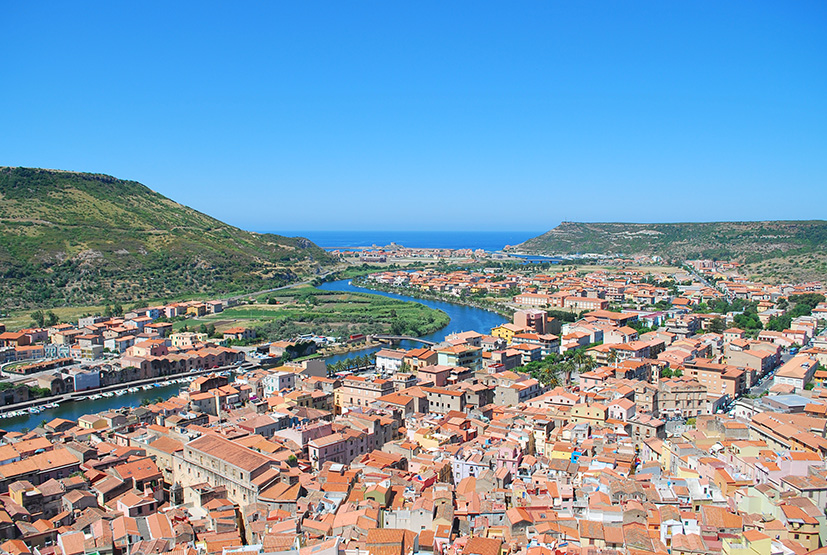
One of the most remarkable aspects of Castello Serravalle is undoubtedly the panoramic view from its walls and terraces. Its elevated position at the top of the hill provides a 360-degree view over Bosa, the Temo River, the coast, and the inland areas, offering a visual spectacle that alone is worth the climb.
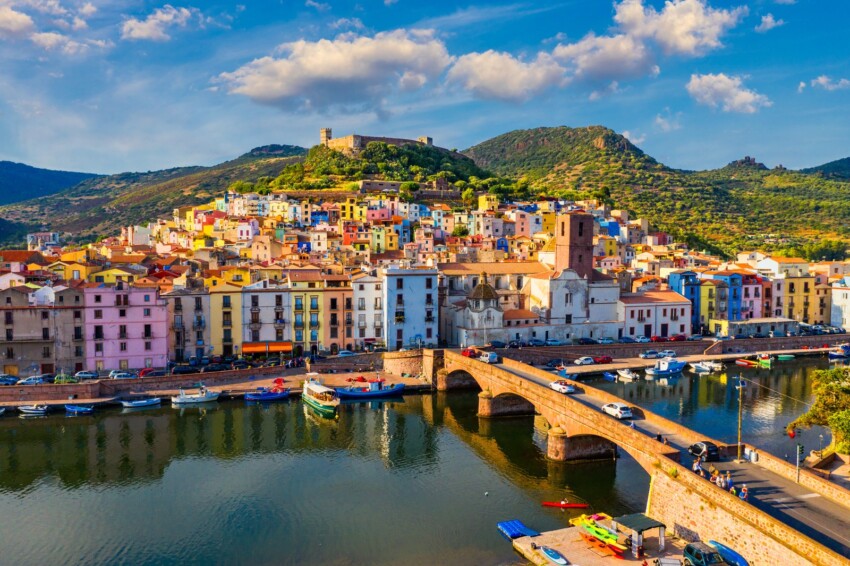
Looking downhill, the eye embraces the entire historic center of Bosa, with its characteristic multicolored houses climbing up the hillside to the castle’s base. Red-tiled rooftops, pastel facades, and narrow medieval alleys create a mosaic of rare beauty, contrasting with the deep blue Sardinian sky.
To the west, the Temo River winds peacefully through the hills before flowing into the Mediterranean Sea. Its mouth, with fishing boats moored along the banks and riverside vegetation, offers a bucolic scene that looks like it belongs in a painting. On the clearest days, you can look north and south along the coast, discovering hidden coves, cliffs overhanging the sea, and the endless blue expanse that merges with the horizon.
To the east, the landscape is dominated by Sardinia’s inland hills, dotted with olive groves, vineyards, and Mediterranean scrub. In the distance, on the clearest days, you can spot the peaks of the Marghine and Montiferru mountains, completing this extraordinary natural panorama.
The view from Castello Malaspina changes constantly throughout the day, offering a variety of spectacles: the dawn gilding Bosa’s facades, the dazzling midday light enhancing the colors, the sunset painting the sky and sea with pink and orange hues, and finally the night hours, when the town lights twinkle like stars beneath the ancient fortress.
There is no doubt that this view is one of the main reasons why Castello Serravalle is considered one of the top sights in Bosa and a must-see destination for anyone visiting this part of Sardinia.
Events and Festivals
Serravalle Castle is not just a historical monument to be admired passively, but a vibrant space that hosts numerous cultural events and festivals throughout the year, offering visitors a variety of engaging and ever-interesting experiences.
During the summer, the castle becomes an evocative venue for classical, jazz, and traditional Sardinian music concerts, organized as part of festivals and cultural programs that attract nationally and internationally renowned artists. The ancient walls also provide a stunning backdrop for theatrical performances and literary readings, creating a magical atmosphere under the summer stars.
Particularly enchanting are the events tied to the celebration of Our Lady of Regnos Altos, held on the Saturday and Sunday of the second week of September. On this occasion, the castle becomes the heart of religious celebrations and popular festivities that involve the entire community of Bosa and attract visitors from all over Sardinia. The procession that carries the statue of the Madonna from the castle’s church through the streets of the old town is one of the most emotional and well-attended moments of the year.
For history and archaeology enthusiasts, conferences, seminars, and historical reenactments are periodically organized to deepen the understanding of the monument and its historical context. Educational workshops for children and teenagers are especially appreciated, offering hands-on experiences and playful learning about the castle’s history and medieval traditions.
While the event calendar is richer during the summer months, cultural initiatives are held even in winter, often linked to Christmas festivities or Carnival, one of the most significant moments in Bosa’s traditional calendar.
To check upcoming events during your visit, it’s recommended to consult the official website of the Municipality of Bosa or visit the local tourist office, which provides updated information on all scheduled events at Serravalle Castle
Tips for Visiting
To make your visit to Malaspina Castle enjoyable and complete, here are some practical tips to keep in mind:
First of all, it is advisable to wear comfortable shoes suitable for walking on uneven surfaces and for climbing from the center of Bosa up to the castle. Layered clothing is recommended in every season: even in summer, the breeze at the top of the hill can be cool, while in winter, it’s important to protect yourself from the wind that often blows across the summit.
Bring a bottle of water with you, especially if visiting during the warmer months, as there are few refreshment points along the uphill path. Inside the castle, there is a small shop where you can buy water, drinks, and snacks, but it’s always best to come prepared.
Don’t forget your camera or a smartphone with a good camera: the view from Serravalle Castle is one of the most spectacular in western Sardinia, and you’ll be able to take unforgettable photos of both the landscape and the architectural details of the monument.
To fully appreciate the historical and artistic value of the castle, especially the frescoes in the Church of Our Lady of Regnos Altos, joining a guided tour is highly recommended. Local guides can enrich your experience with details about the castle’s history, anecdotes, and legends not found in standard guidebooks.
If you are particularly interested in photography, the best time to visit is during the so-called "golden hours"—at sunrise or sunset—when the light takes on warm tones that enhance the reddish color of the trachyte stone and create striking contrasts with the blue sky and sea.
Finally, take your time to not only admire the monument itself but also to soak in the unique atmosphere surrounding it. Sit on the ancient walls and let your gaze wander to the horizon, imagining what life must have been like here centuries ago when Serravalle Castle was the political and military center of the region.
Conclusion
Serravalle Castle is much more than just a tourist attraction: it is a symbol of identity for Bosa, a place where history, art, legend, and nature come together to create a unique and deeply moving experience for visitors.
From its ancient walls, which have withstood the elements and the passage of time for over eight centuries, you can enjoy one of the most extraordinary views in Sardinia—a living picture that changes in color and mood with the passing hours and seasons. Inside the Church of Our Lady of Regnos Altos, 14th-century frescoes tell stories of devotion and artistry, bearing witness to the island’s rich cultural heritage.
Every stone of Malaspina Castle tells a story, every corner may hide a legend, and every panoramic view invites contemplation and reflection. In an era of fast and often superficial tourism, this place instead calls for slowness, gradual discovery, and a willingness to listen to what ancient stones have to say.
For anyone wondering what to see and do in Bosa, the castle is undoubtedly the first answer—the perfect starting point to understand the soul of this beautiful town.
Enjoyed this article?
Support my work and help me create more Sardinia travel guides like this one.
This article is part of the series “Discovering Sardinia,” dedicated to exploring the island’s hidden gems. For more insights into other Sardinian destinations, check out the other articles in this section.

Subscribe to my Newsletter