


Reading time: 12 minutes
Table of Contents
-
-
- Introduction: Sardinia is not just about the sea
- The mysterious Nuragic civilization
- What are nuraghi?
- How old are nuraghi and how many are there in Sardinia?
- The Nuragic complex of Barumini - Bronze Age jewel
- History of the discovery and exploration of Su Nuraxi
- Where is Barumini and how to get there?
- Practical information for visiting
- When is it best to visit Barumini?
- What to see in the surroundings of Barumini?
- Conclusion: why the Nuragic complex deserves your attention
-
Sardinia is not just about the sea
Sardinia is known to most travelers as an island with breathtaking beaches and crystal-clear sea. And indeed, the Sardinian coast is rightfully considered one of the most beautiful in the world. However, this Mediterranean island holds secrets and treasures that go well beyond a beach vacation.
One of Sardinia's most surprising attractions is located far from the coast, in the heart of the island: the Nuragic complex Su Nuraxi of Barumini, recognized by UNESCO as a World Heritage Site. These ancient stone structures testify to the existence of a unique Nuragic civilization that flourished in Sardinia more than 3,500 years ago.
For those interested in history, archaeology, or who simply love discovering something new and unusual, the Nuragic complex of Barumini represents a true treasure chest of antiquity, mysteries, and unique architectural solutions without equal in the world.

The mysterious Nuragic civilization
The Nuragic civilization is one of the most mysterious cultures of the ancient Mediterranean. It existed in Sardiniaapproximately from 1800 BCE until 238 BCE, when the island was conquered by the Romans. This means that the Nuragic culture flourished for over 1,500 years, making it one of Europe's longest-lasting civilizations.
The most surprising thing about this civilization is that it developed almost in isolation from other Mediterranean cultures, maintaining its uniqueness despite contacts with Phoenicians, Etruscans, and other ancient peoples. The Nuragic culture takes its name from the characteristic stone constructions - the nuraghi - that its representatives built.
Very little information has reached us about the language, writing, and beliefs of the Nuragic people. However, the artifacts found and the architectural structures testify to the high level of development of this civilization. They were skilled metallurgists, created complex irrigation systems, had a developed economy, and, apparently, a complex social structure.
One of the most intriguing features of the Nuragic culture are the bronze statuettes, known as "bronzetti," which depict warriors, chiefs, animals, and mythical beings. These statuettes show a high level of development in metallurgy and art, and also offer an idea of the appearance, weapons, and social organization of the Nuragic people.
What are nuraghi?
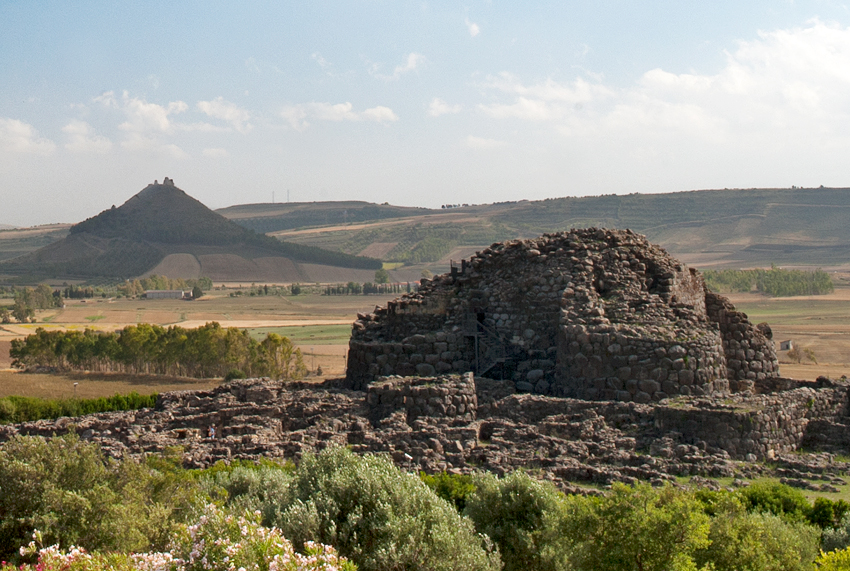
Nuraghi are unique megalithic structures, without equivalents in the world. The word "nuraghe" derives from the proto-Sardinian root "nur," which means "hollow" or "empty inside." They are tall tower-shaped constructions, composed of unworked or roughly worked stone blocks without the use of mortar - a technique known as "dry construction."
A typical nuraghe has the shape of a truncated cone and consists of several floors with circular internal chambers, covered by a false dome - a structure where each successive row of stones protrudes slightly compared to the previous one, narrowing towards the top. This complex architectural technique testifies to the profound mathematical and engineering knowledge of the ancient builders.
Nuraghi can be simple (a single tower) or complex (a central tower with several additional towers, connected by walls). Around many nuraghi, entire settlements were built with dwellings, workshops, cult structures, and burials.
For a long time, the purpose of nuraghi remained an enigma for researchers. Various theories have been proposed: from defensive structures and dwellings of chiefs to temples and astronomical observatories. Modern archaeologists lean toward the version that nuraghi were multifunctional constructions, which could simultaneously serve as fortifications, administrative centers, storage places for supplies, and symbols of the power of local chiefs.

How old are nuraghi and how many are there in Sardinia?
Nuraghi were built over a long period, approximately from 1800 to 500 BCE, with a peak of building activity between 1500 and 1200 BCE. This means that the oldest nuraghi are about 3,800 years old today!
As for the number, the exact total of nuraghi in Sardinia is still unknown. According to various estimates, there are between 7,000 and 10,000 of these structures on the island, although many of them have been preserved only partially. This means that for every 3 square kilometers of Sardinian territory, there is approximately one nuraghe - an impressive density for prehistoric monuments!
Not all nuraghi are equally well preserved. Some are just piles of stones, others have maintained only the lower levels of the structure. But there are some that have come to us in a surprisingly good state of preservation, allowing scholars and tourists to see how these majestic constructions appeared thousands of years ago. And the most famous, well-preserved, and thoroughly studied Nuragic complex is precisely Su Nuraxi of Barumini.
The Nuragic Complex of Barumini - Bronze Age Jewel
Su Nuraxi di Barumini, which in Sardinian simply means "The Nuraghe of Barumini," is the most famous nuragic monument and a true jewel of Sardinian archaeological heritage. In 1997, UNESCO included it in the World Heritage List as an exceptional example of architectural genius and social inventiveness of the Nuragic civilization.
The Barumini complex is not just a single nuraghe, but an entire fortified citadel with a central tower approximately 18.5 meters high (although only about 14 have been preserved to our days), four corner towers connected by walls, and a vast settlement around it. It is a classic example of a "complex nuraghe."
The central tower is the oldest part of the complex, dated approximately to 1500 BCE. Subsequently, between 1300 and 1100 BCE, four lateral towers and the walls connecting them were added, forming an internal courtyard. In the period from 1100 to 900 BCE, a large settlement with dozens of circular houses, workshops, and public buildings grew around this central complex.
The peculiarity of Barumini is that here one can trace the evolution of Nuragic architecture and society for almost a millennium. The nuraghe went through several phases of construction and renovation, each reflecting changes in technologies, social organization, and defensive needs of the Nuragic people.
The internal structure of the nuraghe is no less impressive than its external appearance. The three floors of the central tower are connected by an internal spiral staircase, skillfully integrated into the thickness of the wall. At each level there are circular chambers with niches and corridors. A complex system of passages connects the central tower with the lateral ones, creating a true labyrinth inside the powerful defensive structure.

History of the Discovery and Exploration of Su Nuraxi
Despite its imposing size, the Su Nuraxi 'e Cresia complex (Su Nuraxi 'e Cresia), also known as the nuraghe of Barumini, remained hidden from researchers' eyes for a long time. Although local inhabitants naturally knew about the existence of the ancient ruins, systematic excavations here began only in the mid-20th century.
The true discovery of Su Nuraxi for science is linked to the name of the eminent Sardinian archaeologist Giovanni Lilliu, often called the "father of Sardinian archaeology." In 1950, Lilliu began excavations at the foot of the Barumini hill, which locals called "Su Nuraxi" (The Nuraghe). To the researchers' surprise, beneath layers of earth and stones lay not just another nuraghe, but an entire ancient city of exceptional archaeological value.
The excavations continued until 1957 and led to sensational discoveries. Lilliu and his team uncovered not only the nuraghe itself with its complex structure of towers and walls, but also the surrounding settlement with numerous dwellings, utilitarian structures, and artifacts.
Since archaeological studies in Barumini continue to this day, scholars can only hypothesize about the exact chronology of the complex's construction. Currently, three main phases of the nuraghe's development are distinguished:
1. The initial construction of the central tower (mastio)
2. The second phase, when the south and east towers were built, as well as the walls connecting them
3. The third phase, when the western perimeter tower was erected, notable because, unlike other parts of the complex built with local marl, it was made of basalt, which indicates an obvious change in building material
Archaeological findings at Su Nuraxi show a cultural stratigraphy covering the period from the Nuragic civilization (starting from the late Bronze Age, 1300 BCE, and the final Bronze Age, 1100-800 BCE) to the Roman period (late republic and late empire) and the early Middle Ages. After the ancient period, the Su Nuraxi area continued to be used during the Giudicati era, until the construction of Palazzo Zapata.
The towers, which were originally much taller, have now lost their upper parts. They had a truncated-conical shape and contained superimposed circular chambers inside with projecting walls and tholos (or false dome) covering. Currently, inside Casa Zapata, the mastio and the east tower are visible, while the south and west towers, the double antemural, and the village develop outside this structure.
Large polygonal blocks of local marl, arranged in horizontal rows, were used for the construction of the nuraghe. Sporadically, basalt is also found—a harder volcanic rock from the slopes of the Giara plateau. Interestingly, this material was the main one used in the construction of the more famous Su Nuraxi of Barumini.
Lilliu's work was revolutionary not only for the scope of the discovery but also for his scientific approach. He carefully documented the findings, developed a chronology of the complex's development, and proposed an interpretation of its functions based on archaeological data. Lilliu's research laid the foundations for the modern understanding of the Nuragic civilization and its significance in Mediterranean history.
After the completion of the main excavations, conservation and partial restoration work was carried out on the complex to preserve it for future generations and make it accessible to visitors. In 1997, largely due to the scientific significance of Lilliu's discoveries, Su Nuraxi was included in the UNESCO World Heritage List.
Today, the study of the complex continues, using modern archaeological methods, including geophysical research and 3D modeling, which help scientists understand more deeply the structure and functions of this extraordinary monument.
Where is Barumini and How to Get There?
The Su Nuraxi nuragic complex is located on the outskirts of the small town of Barumini, in the central part of the island. Barumini is about 60 kilometers north of Cagliari, the capital and largest city of Sardinia.
There are several ways to reach Barumini:
By car:
The most convenient way is to rent a car in Cagliari or another major city in Sardinia. From Cagliari to Barumini, you can get there in about an hour by taking the SS131 road, and then the SP197. The route is well marked with signs. In Barumini, there is free parking for visitors to the nuragic complex.
By public transport:
Buses to Barumini depart from the ARST bus station in Cagliari (Piazza Giacomo Matteotti, 8, 09123 Cagliari CA). Schedules may vary depending on the season, so it's advisable to check updated information in advance on the official ARST website or at tourist information centers. The bus journey takes about 1.5-2 hours. Bus numbers: 436, 501. Tickets can be purchased at the station or at tobacco shops.
With an organized excursion:
Many tourist agencies in Cagliari and other major cities in Sardinia offer day trips to Barumini. It's a convenient option if you don't have a car or prefer an organized tour with a guide. These excursions usually include transportation, entrance tickets, and the services of a professional guide.
From other cities in Sardinia:
If you're not staying in Cagliari but in another city in Sardinia, the distances and travel times will be different:
- From Oristano: about 70 km, 1 hour by car
- From Alghero: about 180 km, 2-2.5 hours by car
- From Olbia: about 230 km, 2.5-3 hours by car
Upon arrival in Barumini, finding the complex itself won't be difficult—there are signs in town pointing to Su Nuraxi. From the center of Barumini to the entrance of the archaeological complex is a 10-15 minute walk.
Practical Information for Visiting
Opening Hours
The Barumini nuragic complex is open to visitors all year round, but hours vary depending on the season:
Hours for 2025
- November, December, January, and February: Daily from 9:00 to 17:00 (last entry at 16:00)
- March: from 9:00 to 17:30 (last entry at 16:30)
- April: from 9:00 to 19:30 (last entry at 18:30)
- May, June, July, August: from 9:00 to 20:00 (last entry at 19:00)
- September: from 9:00 to 19:30 (last entry at 18:30)
- October: from 9:00 to 18:30 (last entry at 17:30)
On holidays (January 1, Easter, December 25), hours may vary, so it's advisable to check information in advance on the official website or by phone.
Ticket Costs (for the 2024/2025 season)
The cost of entrance tickets is:
- Full ticket: 15 euros
- Reduced ticket (for students, seniors, groups): 13 euros
- Children up to 7 years: free
Tickets can be purchased at the ticket office at the entrance to the complex or by contacting the booking office in advance, which is recommended during high season to avoid queues.
Zona Archeologica Su Nuraxi
Viale Su Nuraxi - 09021 Barumini (SU)
tel. +39 070 9368128
e-mail:

Guided Tours
Visiting the nuragic complex is only possible with a guide. Guided tours are regularly conducted throughout the day in Italian, English, French, German, and Spanish. The duration of the visit is approximately 1 hour.
During high season (July-August), it is recommended to book your visit time in advance, as the number of visitors who can be on the complex grounds simultaneously is limited for safety reasons and monument conservation.
Inside the complex, there is an information center where brochures and maps in different languages can be obtained, as well as a small souvenir shop selling books, reproductions of nuragic artifacts, and other mementos.
No special permission is required for photography, but the use of flash inside the nuraghe is prohibited. It is also forbidden to touch the walls and artifacts to minimize impact on the ancient structures.
*Book Tours and Activities in Barumini
**By clicking the banner, you'll be redirected to our partner’s website to book tours and experiences. www.Miasardegna.eu is not responsible for services purchased through external platforms
When is it Best to Visit Barumini?
Su Nuraxi can be visited at any time of the year, but each season has its peculiarities:
Spring (April-May) - one of the best periods for visiting. The weather is comfortable, not too hot, nature around is blooming, and there are relatively few tourists. It's the ideal period for those who want to combine visiting archaeological monuments with enjoying beautiful landscapes.
Summer (June-August) - high tourist season in Sardinia. In Barumini, it can be quite hot, especially in the middle of the day, and the number of visitors increases significantly. If you plan to visit in summer, it's better to come early in the morning or towards evening, when it's not so hot and there are fewer people.
Autumn (September-October) - another excellent period for visiting. The weather is still warm, but not as scorching as in summer, the tourist flow decreases, and nature takes on warm autumn tones.
Winter (November-March) - the quietest period in terms of tourists. The weather in Sardinia in winter is mild, but there can be rainy days. The advantage of a winter visit is the absence of queues and the possibility of a more tranquil and unhurried visit to the complex.
Regardless of the season, it is recommended to dedicate at least half a day to visiting Barumini, to see not only the nuragic complex itself but also other attractions of the town at a leisurely pace.


What to See in the Surroundings of Barumini?
A visit to the Su Nuraxi nuragic complex can be combined with visits to other interesting places in the vicinity of Barumini:
Palazzo Casa Zapata - located in the center of Barumini, a few minutes' walk from Su Nuraxi. This 16th-century palace is built right above the ruins of an ancient nuraghe! The building now houses a museum, where you can see the base of the nuraghe under a glass floor, as well as a collection of artifacts found during excavations in Barumini and the surrounding area. A combined ticket allows you to visit both sites at a discount.
Church of the Immaculate (Chiesa dell'Immacolata) - the main church of Barumini, built in the 17th century. The church facade is decorated with interesting bas-reliefs, and inside you can see wooden sculptures and an ancient organ.
Giara di Gesturi - a unique natural plateau, located just 13 kilometers from Barumini. It's a huge basaltic plateau of about 45 square kilometers, known for its unique ecosystem and, particularly interestingly, for a herd of wild horses - the "cavallini della Giara." These small horses (withers height of about 120-130 cm) have lived here since prehistoric times. On the plateau, you can also see nuragic ruins, dolmens, and other ancient structures.
Las Plassas - a medieval castle on top of a hill, offering spectacular views of the surrounding countryside. It is located about 10 kilometers from Barumini.
Many visitors combine the trip to Barumini with a broader tour of central Sardinia, including visits to other nuraghi, prehistoric tombs "domus de janas," and picturesque mountain villages with their traditional lifestyle and cuisine.
Why the Nuragic Complex Deserves Your Attention
The Barumini nuragic complex is much more than simple ancient ruins or a tourist attraction. It's a window into a unique and mysterious civilization that flourished in Sardinia thousands of years ago, long before the Romans and even the classical Greek civilization.
Visiting Su Nuraxi offers a rare opportunity to discover the prehistoric past of the Mediterranean and see with your own eyes the impressive architectural achievements of the ancient Sardinians. The massive stone towers, complex internal structures, and the skill of the builders, who worked without modern technologies, cannot but evoke admiration.
The complex is interesting not only for historians and archaeologists but for anyone who wants to discover more about Sardinia than what the typical beach vacation offers. It's a place where history comes alive, where you can imagine the life of Bronze Age people, their struggle for survival, their beliefs, their social organization.
The inclusion of Su Nuraxi in the UNESCO World Heritage List emphasizes its exceptional universal value as a testimony to humanity's ingenuity and creative genius. As stated in the official UNESCO citation: "Su Nuraxi of Barumini is an exceptional example of a type of architectural ensemble that illustrates a significant phase in human history."
For travelers seeking authentic and unique experiences outside the usual tourist routes, Barumini offers immersion in the ancient history of Sardinia, surrounded by picturesque countryside and a traditional lifestyle that has largely been preserved in the central regions of the island.
So, when planning a trip to Sardinia, make sure to dedicate a day to visiting Barumini. It's a journey through time that will give you an unforgettable experience and a deep understanding of the unique historical and cultural heritage of this extraordinary island.

Enjoyed this article?
Support my work and help me create more Sardinia travel guides like this one.

Subscribe to my Newsletter