


Reading time: 6 minutes
Table of Contents
- Introduction
- The Origins of the Festival
- How the Procession Takes Place
- Traditional Costumes
- The 2025 Sant’Efisio Celebration
- How to Take Part in the Event
- Practical Tips for Visitors
- The Cultural Importance of the Celebration
- Conclusion
Introduction
Among the many festivals celebrated across Sardinia, the Feast of Sant’Efisio in Cagliari stands out as the most heartfelt and significant religious and folkloric event on the island. Every year, on May 1st, the Sardinian capital becomes a living stage where faith, tradition, and culture intertwine in a show of remarkable beauty and emotional intensity.
The procession in honor of the martyred saint, held uninterruptedly since 1657, draws thousands of visitors from around the world each year. It offers a fascinating and authentic glimpse into Sardinian culture. If you're wondering what to do in Sardinia in May, attending this centuries-old celebration is a unique and unforgettable experience that immerses you in the island’s most deeply rooted traditions.
With its parades of traditional costumes from all over Sardinia, ox-drawn carts, devotional songs, and atmosphere of profound spirituality, the Feast of Sant’Efisio is not just a religious event — it’s a powerful expression of Sardinian cultural identity and is considered one of the most important religious processions in the Mediterranean.
The Origins of the Festival
The roots of devotion to Sant’Efisio go back to the 17th century, during a devastating plague that struck Cagliari in 1652. According to tradition, city officials vowed to honor the saint with an annual solemn procession if the plague ended. Miraculously, it did — and the vow has been faithfully upheld ever since.
Efisio was a Roman officer of Asian origin who converted to Christianity. He was sent to Sardinia by Emperor Diocletian to persecute Christians, but during the journey he had a vision that led to his conversion. He was subsequently imprisoned and martyred in Nora on January 15, 303 AD, becoming one of the island’s first Christian martyrs.
The first procession was held on May 1, 1657, and has taken place every year since — even during the world wars — symbolizing a remarkable thread of historical and cultural continuity. The 2025 edition will mark the 369th Sant’Efisio celebration, a testament to the tradition’s endurance and deep cultural roots.
How the Procession Takes Place
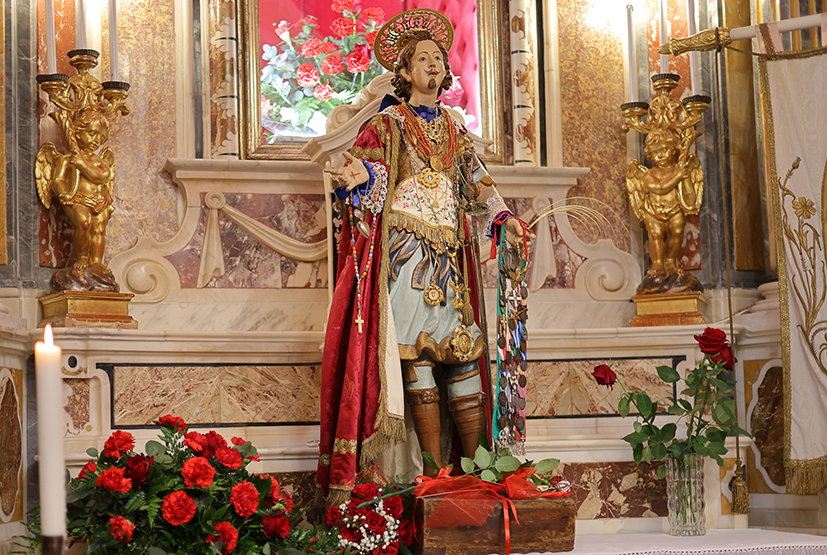
Preparations begin as early as the end of April. During this period, the Archconfraternity dresses the statue of the Saint. On April 30th, the adornment is completed by decorating the statue with gold and jewelry donated by the faithful as a sign of devotion. Finally, the President of the Archconfraternity and the Chief Sacristan place the statue on the ceremonial carriage.
On May 1st, at dawn, Su Carradori, the person in charge of guiding the oxen, decorates the animals with flowers and bells. Then, the Third Guardian on horseback, along with members of the Guardianìa (Guard Corps), goes to the City Hall, where he meets the Alter Nos, the official representative of the Mayor of Cagliari. Together, they proceed to the Church of Sant’Efisio for the celebration of the "Alter Nos Mass".
After these civil and religious rituals — including the investiture of the Alter Nos and the appointment of Guardians from among the confreres — the procession gets ready to depart.
The statue of Sant’Efisio, placed on the gala carriage, is escorted by the Archconfraternity of the Gonfalone and followed by faithful from all over Sardinia. The procession begins with the Cavalieri del Campidano (Campidano horsemen), riding horses richly adorned with rosettes and ribbons. They are followed by the Miliziani, armed with arquebuses and sabres, and then the Guardianìa, on horseback and dressed in elegant black tailcoats with blue sashes. The Third Guardian carries the Gonfalon of the Archconfraternity, followed by the Alter Nos in top hat and tails, with the tricolor sash.
Behind them march the members of the Confraternity, led by an 18th-century crucifix. At the sides of the carriage are the Collaterali, two confreres responsible for opening the carriage doors at rest stops, allowing the faithful to offer flowers, ex-votos, and prayers.
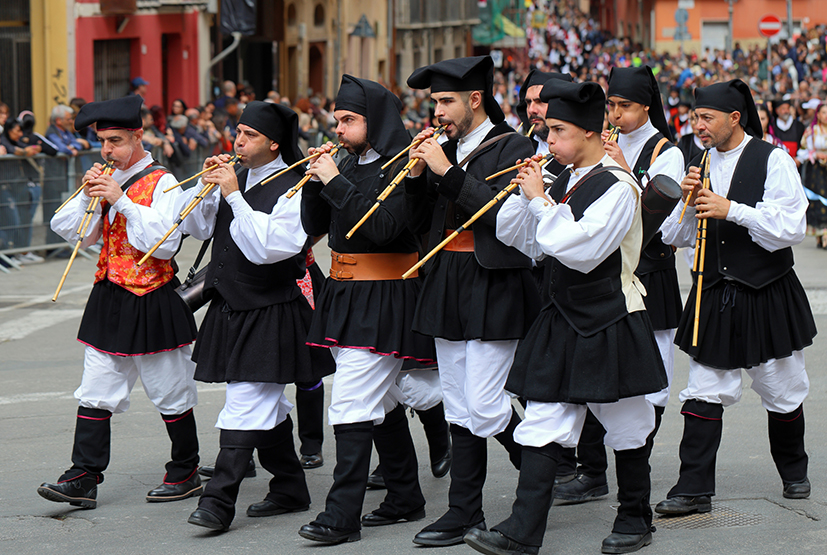
One of the most emotional moments occurs when the procession passes in front of the Town Hall on Via Roma: the arrival of the carriage, heralded by the sound of launeddas and religious songs in the Sardinian language, is also greeted by the sirens of ships in the port. Part of the route is carpeted with flowers and herbs in a ritual called s'arramadura, a floral tribute to the Saint.
After crossing Cagliari and paying homage to the Fishermen’s Village, the procession reaches the small Church of Sant’Efisio in Giorgino, where the statue is stripped of its jewels and dressed in simpler garments. It is then transferred to a travel carriage, known as the "cocchio di campagna" (country carriage).
The pilgrimage continues towards Maddalena Beach, where pilgrims from Capoterra (formerly known as Villa Sant’Efisio) join in, with a first stop for Mass in the area of Su Loi.
In the evening, the statue arrives at the Chapel of Villa d'Orri, the historic residence of the Marquises Manca of Villa Hermosa, where a Eucharistic blessing is held. From there, the procession continues to Sarroch, where a solemn Mass is celebrated at the Church of Santa Vittoria, concluding the first day.

On May 2nd, the procession continues through Villa San Pietro and Pula. Since 1943, a significant stop has been added at Villa Atzori. In Pula, the Alter Nos symbolically hands over the duty of safeguarding the Saint to the Mayor. After Mass at the Church of San Giovanni Battista and stops at the cemetery and the small church of San Raimondo, the procession reaches Nora, the final destination, around 9:00 PM, where the statue is placed in a niche.
May 3rd is dedicated to the commemoration of the martyrdom: throughout the day, Masses and religious services are celebrated. In the afternoon, a procession takes place along the shoreline: the statue, carried on the shoulders of the confreres, passes through the sites of the martyrdom.
On May 4th, the return journey to Cagliari begins. In the evening, upon the arrival of the carriage at the Church of Stampace, the solemn Rite of the Fulfillment of the Vow takes place, bearing witness to the promise faithfully kept by the people of Cagliari to their patron saint.
Traditional Costumes
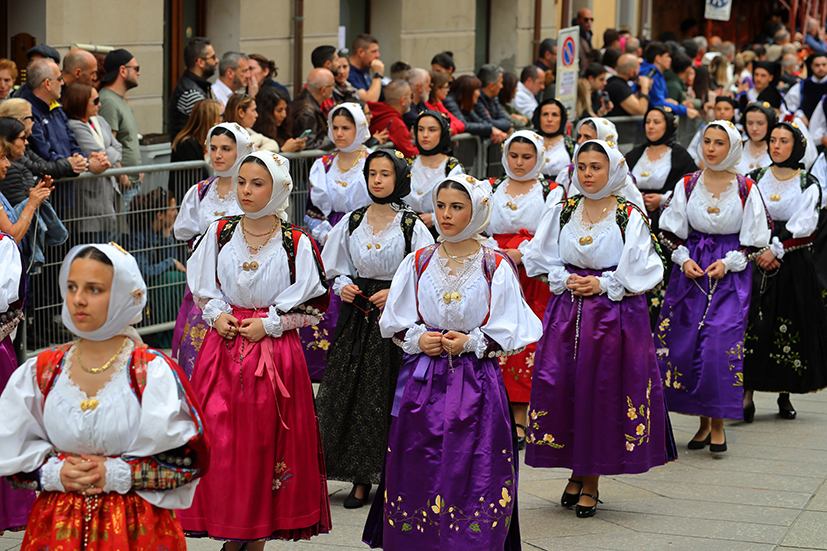
One of the most fascinating aspects of the Sant’Efisio Festival is the parade of traditional Sardinian costumes, true masterpieces of textile craftsmanship that tell the story of the island’s rich cultural heritage. Every town in Sardinia participates with its own typical garments, creating a kaleidoscope of colors, fabrics, and jewelry that highlights the extraordinary diversity of the island’s cultural traditions.
Women wear elaborate pleated skirts, embroidered bodices, finely crafted linen shirts, and precious gold or silver filigree jewelry. On their heads, they wear shawls and veils that vary depending on their region of origin. Men parade in orbacetrousers (a typical Sardinian wool fabric), colorful vests, caps, and bandoliers.
Especially striking are the costumes from Orgosolo, Desulo, Fonni, and Oliena, known for their vibrant colors and intricate embroidery, as well as those from Quartu Sant’Elena. The jewelry also deserves special attention—particularly the filigree buttons, multiple rings, and gold rosaries that complete the women's outfits.
This showcase of traditional costumes makes the Sant’Efisio Festival an extraordinary opportunity to admire a living cultural heritage, passed down from generation to generation with pride and passion.
The 2025 Sant’Efisio Celebration
In 2025, the Sant’Efisio Festival promises to be even more special. The event will begin on May 1st with the traditional dressing of the saint and continue with the procession, which will pass through the heart of Cagliari before heading toward Nora. A larger turnout is expected, along with additional events such as concerts, exhibitions, and tastings of local products.
The full religious program of the event is available on the official website of the Municipality of Cagliari.
How to Take Part in the Event
Taking part in the Sant’Efisio Festival is relatively simple but requires good planning, especially if you want to witness the key moments of the procession.
Attendance is free and open to everyone. It’s advisable to arrive early on May 1st to find a good spot along the route, especially in iconic areas like Via Roma or the Stampace district.
For those who want to fully experience the event, it’s possible to join the pilgrims along the way or attend the religious services held at the various stops.
If you're planning to attend the 2025 Sant’Efisio Festival, here are some practical tips that may come in handy:
-
Book your accommodation well in advance, as Cagliari and nearby areas tend to fill up quickly during the festival days.
-
Wear comfortable clothing and walking shoes, as you’ll be standing for hours watching the procession.
-
Bring water, a hat, and sunscreen, especially if the weather is hot, since most of the event takes place outdoors.
-
Check available parking areas if you're traveling by car, bearing in mind that the historic center may be closed to traffic.
-
Take the opportunity to taste traditional sweets made especially for the festival, such as pardulas and sebadas.
-
Respect the religious nature of the event by maintaining appropriate behavior during the procession and church services.
-
Consider extending your stay to explore other things to do in Sardinia in May, such as visiting archaeological sites, enjoying nature hikes, or participating in food and wine tours.
The Cultural Importance of the Celebration
The Sant’Efisio Festival goes far beyond its religious dimension. It is a fundamental part of the cultural identity not only of Cagliari but of the whole of Sardinia. Recognized as one of the most important religious processions in the Mediterranean, it has been included in the Register of Intangible Cultural Heritage of Sardinia and is a candidate for UNESCO Intangible Cultural Heritage status.
This celebration is a remarkable example of how traditions can remain alive through the centuries, adapting to social changes without losing their essence. The active participation of communities from across the island, who contribute their costumes, music, and dances, transforms the festival into a moment of social cohesion and an expression of Sardinian identity and pride.
Over the years, the Sant’Efisio Festival has also taken on a significant tourism dimension, serving as an international showcase of Sardinian culture and traditions and contributing to the island's efforts to promote year-round tourism.
Conclusion
The Feast of Sant’Efisio represents an invaluable cultural heritage that continues to thrive with undiminished intensity through the centuries. Taking part in the 369th Sant’Efisio Festival in 2025 means not only witnessing a spectacular folkloric event but also connecting with the most authentic soul of Sardinia—its ancient traditions and deep spirituality.
If you're wondering what to do in Sardinia in May, this festival offers a truly unique experience, combining religious, cultural, and social elements in an event of extraordinary beauty and emotional intensity. The colors of traditional costumes, the sounds of the launeddas (ancient Sardinian reed instruments), and the scents of flowers and incense create an unforgettable atmosphere that conveys the essence of Sardinian identity better than any book or museum.
As every year, the Sant’Efisio Festival 2025 will be a moment of collective celebration, renewing the bond between past and present, between tradition and modernity. It confirms the central role that festivals continue to play in Sardinia’s cultural and social life. It is an unmissable event for anyone wishing to discover the most authentic and passionate face of the island.
This article is part of the "Discovering Sardinia" series, dedicated to exploring the island’s hidden gems. For more insights into other Sardinian destinations, check out the other articles in the section.
Enjoyed this article?
Support my work and help me create more Sardinia travel guides like this one.

Subscribe to my Newsletter