


Reading time: 15 minutes
Table of Contents
- Introduction
- History and Traditions of Bread in Sardinia
- Main Varieties of Sardinian Bread
- Cultural and Ritual Significance of Bread
- Sardinian Bread Today
- Conclusions
Introduction
The island of Sardinia stands as a bastion of culinary traditions that have withstood the test of time, and at the heart of Sardinian cuisine lies its extraordinary bread-making heritage. Unlike anywhere else in Italy or perhaps the Mediterranean, Sardinia has developed a bread culture of remarkable diversity, complexity, and cultural significance that continues to thrive in the modern era.
For anyone considering what to eat in Sardinia, bread is not merely an accompaniment to meals but often the star of the table—a testament to the islanders' ingenuity and their deep connection to wheat cultivation that stretches back to Neolithic times. From the paper-thin pane carasau that can last for months without spoiling to the intricately decorated pane coccoi that transforms bread into edible art, the variety of Sardinian bread reflects the island's geographic diversity and historical isolation.
This uniquely Sardinian approach to breadmaking emerged from necessity in a challenging landscape where preservation was crucial and where bread often needed to sustain shepherds during long periods away from home. Yet beyond its practical origins, traditional Sardinian bread has evolved into a profound cultural expression—bread in Sardinia tells stories, marks celebrations, and embodies centuries of communal knowledge passed from generation to generation.
Today, while many traditional foods across Europe have succumbed to industrialization and changing tastes, typical Sardinian breads have shown remarkable resilience. In villages across the island, wood-fired ovens still burn as they have for centuries, and the rhythmic sounds of breadmaking—kneading, shaping, decorating—continue to form the backdrop of Sardinian daily life.
This article explores the rich world of Sardinian bread, from its ancient origins and diverse varieties to its profound cultural significance and contemporary relevance. Through understanding this fundamental element of Sardinia's gastronomic heritage, we gain insight not just into what the Sardinians eat, but into how they have preserved their identity through the most essential of foods.
History and Traditions of Bread in Sardinia
Ancient Origins
The story of Sardinian bread begins in prehistoric times. Archaeological evidence suggests that grain cultivation on the island dates back to the Neolithic period, around 6000 BCE, when the first agricultural communities began to settle in Sardinia. Ancient grinding stones, primitive ovens, and ceramic vessels for grain storage have been discovered at numerous archaeological sites across the island.
By the Bronze Age (1800-500 BCE), during the Nuragic civilization unique to Sardinia, breadmaking had already developed into a sophisticated practice. The significance of bread in this period is evidenced by the discovery of bread-shaped votive offerings in Nuragic sanctuaries, indicating that bread had already transcended its role as mere sustenance to become a symbolic and ritual object.
The Phoenicians, Carthaginians, and later the Romans all influenced Sardinian cuisine and breadmaking techniques during their respective occupations of the island. However, unlike many conquered territories that fully adopted the culinary practices of their rulers, Sardinia's geographical isolation and strong cultural identity allowed it to assimilate outside influences while maintaining distinct local traditions. This selective adaptation is particularly evident in the island's traditional Sardinian bread, which bears little resemblance to bread found on the Italian mainland or other Mediterranean regions once under Roman rule.
Bread in Sardinian Agro-Pastoral Society
The unique development of Sardinian bread was profoundly shaped by the island's predominantly agro-pastoral economy that persisted well into the 20th century. In a society where shepherds would spend months away from home tending flocks in remote pastures, bread needed to be durable, portable, and non-perishable—qualities exemplified by pane carasau, the paper-thin Sardinian flatbread that could last for months without spoiling.
The wheat cultivation and breadmaking cycle structured the agricultural year and reinforced social bonds within communities. Harvest time was a period of intense communal activity, and the subsequent breadmaking process—particularly for special occasions—often involved multiple households working together. This collective approach to breadmaking, known as "sa cotta" (the baking), created a repository of shared knowledge and techniques that was passed orally between generations of women.
The division of labor around bread was strictly gendered in traditional Sardinian society. Men typically handled the cultivation and harvesting of wheat, while women controlled the transformation of grain into bread—a process that conferred significant status and responsibility. A woman's breadmaking skill was considered essential to her identity and social standing, with particularly accomplished bakers enjoying special recognition within their communities.
Evolution and Preservation of an Art
Despite centuries of foreign domination—from the Byzantines and Aragonese to the Piedmontese and finally the Italian mainland—the fundamental techniques and varieties of traditional Sardinian bread have shown remarkable continuity. This persistence stems partly from Sardinia's mountainous geography, which isolated many inland communities and allowed them to maintain practices that might otherwise have been supplanted by outside influences.
The 20th century, however, brought unprecedented challenges to traditional breadmaking. The mechanization of agriculture, rural depopulation as younger Sardinians moved to cities or the mainland for employment, and the introduction of commercial bakeries all threatened to erode centuries-old breadmaking traditions. By the 1970s, many predicted that authentic types of Sardinian bread would soon exist only in folk museums and cultural memory.
Yet contrary to these pessimistic forecasts, the last decades have witnessed a remarkable resurgence of interest in traditional Sardinian bread. This renaissance has been driven by several factors: a broader cultural movement to preserve Sardinian identity, growing international appreciation for artisanal foods, and recognition of the nutritional and gastronomic value of traditionally produced bread. Today, breadmaking knowledge that once seemed destined for extinction is being carefully documented, taught in formal and informal settings, and adapted to contemporary contexts while maintaining its essential character.
Main Varieties of Sardinian Bread
The diversity of typical Sardinian breads is astonishing, with some experts identifying more than 400 distinct varieties across the island. Each region, and often each village, maintains its own specific types, recipes, and techniques. Here we explore the most significant and widely recognized types of Sardinian bread.
Pane Carasau (Carta da Musica)
Perhaps the most emblematic of all Sardinian bread, pane carasau is a paper-thin, crisp flatbread also known as "carta da musica" (sheet music) because it's thin enough to read a sheet of music through it. This thin Sardinian bread is made from durum wheat semolina, water, salt, and yeast, rolled into extremely thin rounds that are briefly baked, separated into two discs, and then baked again until completely crisp.

The genius of pane carasau lies in its remarkable shelf life—it can remain edible for months, making it the perfect provision for shepherds spending long periods in the pastures. Its creation represents a brilliant adaptation to the demands of pastoral life and Sardinia's sometimes harsh environment.
A popular variation is guttiau, which is essentially pane carasau brushed with olive oil and sprinkled with salt before a final toasting. This transforms the plain bread into a delicious snack or accompaniment to meals. In contemporary Sardinian cuisine, pane carasau serves as the base for many dishes, including "pani frattau," where the flatbread is softened with broth and layered with tomato sauce and poached eggs.

Civraxiu
Civraxiu is a large, round bread with a thick, crunchy crust and a soft, porous interior. Made from semolina and common wheat flours, it's characterized by its substantial size—traditionally weighing between 2 and 3 kilograms—and its impressive keeping qualities, remaining fresh for up to a week.
Historically, civraxiu was the daily bread of farming families in the Campidano, Sardinia's southern agricultural plain. Each loaf would feed a family for several days, with the thick crust helping to preserve the soft interior. The preparation involves a sourdough starter (sa madrighe) and a relatively high hydration dough, which gives the bread its characteristic open crumb structure.
Today, civraxiu remains popular throughout Sardinia and represents what many consider the quintessential everyday Sardinian bread—substantial, flavorful, and versatile enough to accompany any meal from breakfast to dinner.

Coccoi
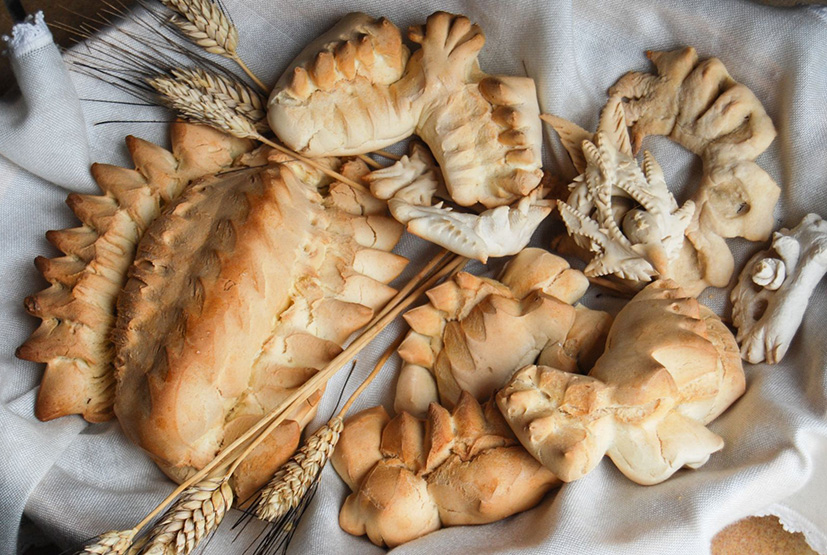
Pane coccoi represents the artistic pinnacle of Sardinian breadmaking. This decorated Sardinian bread is made from finely milled durum wheat semolina and is distinguished by its elaborate decorations and designs. The basic dough is similar to other Sardinian breads, but what sets coccoi apart is the meticulous artistry applied to each loaf.
Using small scissors and specialized tools, bakers create intricate patterns and symbols on the bread's surface—flowers, birds, grapes, wheat sheaves, and geometric designs are common motifs. These designs are not merely decorative but often carry specific symbolic meanings related to fertility, prosperity, and protection.
Traditionally, pane coccoi was reserved for special occasions and rituals. Different designs corresponded to specific celebrations—weddings, baptisms, harvests, or religious festivals each called for particular decorative patterns. The most elaborate forms of coccoi weren't intended for consumption at all but served as ritual objects or gifts, especially during wedding ceremonies where specially designed breads symbolized wishes for the couple's prosperity.
Moddizzosu
Moddizzosu (sometimes called "pane moddizzosu") is a soft, moist bread that represents a distinct departure from the crispness of pane carasau or the substantial crust of civraxiu. Named after the Sardinian word "moddizzosu" meaning "soft," this bread is characterized by its tender crumb and relatively brief shelf life—qualities that make it more similar to breads found on the Italian mainland.
Made from a mixture of durum and soft wheat flours, often with the addition of potatoes in the dough, moddizzosu has a light, airy texture and a distinctive flavor that makes it particularly suitable for accompanying hearty stews and braises common in Sardinian cuisine. It's especially popular in central Sardinian regions like Barbagia and Ogliastra.
The preparation of moddizzosu involves a complex process of multiple risings, careful handling to preserve air bubbles in the dough, and baking at a lower temperature than crisp breads. This creates a loaf with a thin, chewy crust and a soft interior that absorbs sauces beautifully, making it ideal for fare such as "pani 'e saba," where slices are soaked in sapa (cooked grape must) and layered with nuts and dried fruits.
Pistoccu
Pane pistoccu is a thin, twice-baked bread from central-eastern Sardinia that occupies a middle ground between the extreme thinness of carasau and thicker loaf breads. Made primarily from durum wheat semolina, water, and salt, with minimal or no leavening, pistoccu is first baked as a somewhat thick flatbread, then cut into sections and baked again at a lower temperature until completely dry.
The result is a dry, slightly thick cracker-like bread with excellent keeping qualities. Like carasau, pistoccu was developed to sustain shepherds and travelers, but its slightly thicker form provides more substance. When needed, it can be briefly soaked in water or broth to soften it, transforming it into "pistoccu infundidu," a versatile base for various toppings.
In regions like Ogliastra, variations of pistoccu include the addition of potatoes or different types of flour, creating subtle differences in texture and flavor that distinguish one village's version from another's. These regional variations exemplify how traditional Sardinian bread types have evolved to reflect local preferences and available ingredients.

Spianata Sarda
Spianata sarda is a round, flattened bread with a thickness between that of a typical loaf and a flatbread. Its name derives from the Italian "spianare," meaning "to flatten," referencing the technique of pressing the dough into a disc before baking. The bread has a moderate crust and a compact but tender interior.
Made from a mixture of semolina and white flour, spianata sarda is leavened with either sourdough starter or brewer's yeast. What distinguishes it from other Sardinian flatbreads is its balanced texture—neither too crisp nor too soft—making it extremely versatile. It's particularly popular in northern Sardinia, especially around Ozieri and Sassari.
Spianata sarda serves as an excellent base for "pani cunzadu" (seasoned bread), where the bread is topped with olive oil, salt, and various ingredients such as tomatoes, anchovies, or local cheeses—creating what might be considered a Sardinian precursor to pizza. This preparation highlights how what to taste in Sardinia often involves simple combinations that showcase the quality of fundamental ingredients like bread.

Other Regional Varieties
Beyond these major categories lie dozens of regional and local breads that further demonstrate the incredible diversity of traditional Sardinian bread. Each reflects specific local conditions, preferences, and cultural influences:
-
Pane cun gerda: A bread from the Ogliastra region that incorporates wild herbs, particularly wild fennel, creating a distinctively aromatic loaf that pairs beautifully with local cheeses.
-
Su pani 'e fresa: A twice-baked bread similar to pistoccu but specific to the Campidano region, with a slightly different shape and texture.
-
Zichi: A small, round bread from the Bonorva area made with a high proportion of bran, giving it a rustic texture and distinctive flavor that complements strong cheeses and cured meats.
This diversity of types of Sardinian bread reflects not just geographic variations but also historical necessities and cultural preferences that have evolved over centuries, making Sardinian breadmaking one of the most complex and sophisticated bread cultures in the Mediterranean basin.
Cultural and Ritual Significance of Bread
Bread in Religious Festivities
Throughout Sardinia's history, traditional Sardinian bread has played a central role in religious celebrations, creating a sacred dimension to this daily food. The Christian calendar, with its cycle of feasts and fasts, has profoundly shaped bread traditions on the island, with special breads marking important religious occasions.
Easter brings a flourishing of bread production across Sardinia, with distinctive varieties prepared specifically for Holy Week and Easter Sunday. "Coccoi de Pasca" are elaborately decorated with symbols of resurrection and renewal—eggs, doves, flowers, and crosses. In some communities, large ceremonial breads are carried in procession or blessed in church before being distributed to the congregation, physically embodying the sharing central to Christian theology.
The feast of Saint Anthony the Abbot in January features "su pani de Sant'Antoni," bread loaves blessed during the celebration and believed to protect against fire and illness. These blessed breads were traditionally kept in homes throughout the year as talismans, illustrating how Sardinian bread often transcended its nutritional role to become a spiritual object.
All Saints' Day and All Souls' Day in November bring "pani de is mortus" (bread of the dead), special breads that form part of offerings to deceased family members. These often take distinctive shapes—bones, skulls, or human figures—creating a tangible connection between the living and their ancestors through the medium of bread.
Bread in Rites of Passage
Major life transitions in traditional Sardinian society were marked and celebrated with special breads, creating edible monuments to these important moments. For anyone seeking what to taste in Sardinia, these ceremonial breads offer insight into the profound cultural significance of breadmaking on the island.
Weddings featured some of the most elaborate traditional Sardinian bread creations. "Su schirionè" or "sa coccoi de sa sposa" (the bride's bread) was a masterpiece of bread art, often standing up to 60 centimeters tall and decorated with intricate symbols of fertility and prosperity. These wedding breads were presented to the bride, blessed during the ceremony, and sometimes preserved rather than eaten, serving as a lasting reminder of the union.
Birth and baptism called for "su coccoi de partora," bread made to celebrate new mothers and their infants. These often took the form of mother and child figures or were decorated with symbols of protection for the vulnerable new life. Godparents might receive specially shaped breads acknowledging their new spiritual responsibility.
Even courtship involved bread gifts, with young women sometimes presenting elaborately decorated breads to potential suitors as a demonstration of their breadmaking skill—a quality highly valued in a prospective wife. These "coccois de amore" (love breads) might include specific symbols that communicated messages between the couple.
Symbolism and Decorations of Sardinian Bread
The extraordinary decorative techniques applied to decorated Sardinian bread constitute a visual language developed over centuries. Far from being merely ornamental, these designs convey specific meanings understood within Sardinian cultural tradition.
Agricultural motifs dominate ceremonial bread decorations, reflecting Sardinia's agrarian foundations. Wheat sheaves symbolize abundance, grape clusters represent fertility, and agricultural tools acknowledge the labor that sustains life. Birds, particularly doves, feature prominently as symbols of peace and divine presence.
Anthropomorphic symbols appear in festival breads—human figures representing saints, biblical characters, or generalized human forms that connect the bread to the community consuming it. These figurative breads create a powerful symbolic link between nourishment and humanity.
The decoration techniques themselves reveal remarkable sophistication. Using simple tools—small scissors, knives, reed stamps, and pinwheels—Sardinian bakers achieve astonishing detail and precision. These techniques are closely guarded and passed down through generations, with each family often maintaining distinctive decorative styles and motifs.
Beyond visual symbolism, the very sharing of bread carries profound meaning in Sardinian culture. Ceremonial breads are rarely consumed immediately but instead broken and distributed among family and community members, reinforcing social bonds through this most fundamental food. This practice highlights how Sardinian bread serves not just nutritional needs but also reinforces the communal fabric of island society.
Sardinian Bread Today
Tradition and Innovation
The contemporary landscape of Sardinian bread reflects a delicate balance between preserving centuries-old traditions and adapting to modern tastes, technologies, and economic realities. Today's bakers face the challenge of maintaining authenticity while making their craft economically viable in a changed world.
Traditional wood-fired ovens (forni a legna) remain central to authentic Sardinian bread production, despite their labor-intensive nature. These ovens, reaching temperatures of 450-500°C (842-932°F), create the distinctive textures impossible to achieve in conventional modern ovens. Many communities have preserved their communal ovens, which once served entire villages and continue to operate for special occasions or as part of cultural preservation efforts.
Innovation appears most notably in ingredient sourcing. A growing movement centers on ancient Sardinian wheat varieties—"Cappelli," "Karalis," "Senatore," and others—that were nearly lost during 20th-century agricultural modernization. These heritage grains often feature lower gluten content and more complex flavors than modern wheat, creating new interest in traditional Sardinian bread among health-conscious consumers and those with mild gluten sensitivities.
For visitors considering what to eat in Sardinia, this renaissance of traditional breadmaking offers opportunities to taste authentic versions of breads that have sustained the island for millennia. Many agritourism establishments and rural restaurants now proudly serve these heritage breads, often explaining their historical significance and production methods to interested guests.
Recognition and Protection
The cultural and gastronomic significance of Sardinian bread has received increasing formal recognition in recent decades. Several varieties now enjoy protected status under European Union quality schemes, acknowledging their unique characteristics and production methods.
Pane carasau received Protected Designation of Origin (PDO) status, ensuring that bread labeled with this name must be produced according to specific methods within designated geographical areas. This protection helps prevent industrialized versions from appropriating the name while failing to maintain authentic characteristics.
International recognition has also grown through Sardinia's inclusion in the UNESCO Representative List of the Intangible Cultural Heritage of Humanity for aspects of its agro-pastoral culture, which includes traditional breadmaking practices. Such designations acknowledge that traditional Sardinian bread represents not just food but an entire cultural system worthy of protection.
Sardinian Bread in Contemporary Gastronomic Culture
As interest in regional food traditions grows globally, Sardinian bread has found new appreciation beyond the island's shores. Innovative chefs both within Sardinia and internationally have begun incorporating these breads into contemporary cuisine, often in ways that both honor tradition and create new culinary experiences.
Pane carasau, with its distinctive texture and neutral flavor, has proven particularly adaptable to modern culinary interpretations. Beyond traditional preparations like pani frattau, creative chefs use it as a base for sophisticated appetizers, crumble it into soups for texture, or even incorporate it into desserts. The bread's architectural strength makes it useful for constructing visually striking dishes while maintaining its Sardinian identity.
Cooking schools throughout Sardinia now offer classes in traditional breadmaking to both tourists and professional chefs, spreading knowledge that once remained within family circles. These educational initiatives ensure that the techniques required for creating authentic Sardinian bread continue to find new practitioners.
For those seeking what to taste in Sardinia, bread has become a gateway to understanding the island's broader culinary culture. Bread tastings, similar to wine tastings, allow visitors to experience the remarkable diversity of typical Sardinian breads with expert guidance, often paired with local cheeses, cured meats, and wines that highlight regional flavor affinities.
Social media and food tourism have also played roles in raising the profile of Sardinian bread, with the photogenic qualities of decorated Sardinian bread attracting particular attention. This visibility has created new markets for traditional bakers and helped younger generations recognize the value of their breadmaking heritage.
Conclusions
The story of Sardinian bread is a testament to how a fundamental food can embody an entire culture's history, values, and relationship with the land. What began millennia ago as a solution to basic survival needs in a challenging environment has evolved into one of the Mediterranean's most distinctive and sophisticated breadmaking traditions.
The extraordinary diversity of types of Sardinian bread—from paper-thin carasau to elaborately decorated coccoi—reflects the geographic and cultural diversity of the island itself. Each variety tells a story of adaptation, innovation, and cultural meaning that goes far beyond mere sustenance. In these breads, we can read Sardinia's history: its pastoral traditions, its religious devotions, its community structures, and its artistic expressions.
For anyone interested in what to eat in Sardinia, bread offers perhaps the most authentic taste of the island's culinary identity. Unlike more internationally recognized Italian foods that have been standardized through commercialization, traditional Sardinian bread remains deeply rooted in specific localities and cultural contexts, offering a genuine connection to place that has become increasingly rare in our globalized food system.
The resilience of Sardinian bread traditions in the face of modernization suggests a promising future. While many traditional foods have disappeared or been fundamentally altered by industrialization, Sardinia's bread culture has demonstrated remarkable continuity. The current renaissance of interest in artisanal techniques and heritage grains indicates that far from being merely a relic of the past, Sardinian bread continues to evolve while maintaining its essential character.
This living tradition offers lessons that extend beyond Sardinia—about the value of cultural resilience, the importance of knowledge transmission between generations, and the power of food to encode and preserve cultural identity. In every loaf of traditional Sardinian bread, whether enjoyed at a family table in a mountain village or served in a sophisticated restaurant, we taste not just flour, water, and salt, but the accumulated wisdom and creativity of countless generations of Sardinian bakers.
For visitors to the island and culinary enthusiasts worldwide, exploring the world of Sardinian bread provides more than gastronomic pleasure—it offers insight into one of Europe's most ancient and distinctive food cultures, one where daily bread remains, as it has for thousands of years, both physical sustenance and cultural touchstone.

Subscribe to my Newsletter